Criminal Investigation Department
Needful ThingsThe Criminal Investigation Department is the Maine State Police unit that handles murder investigations, and its arrival establishes the boundary between a local officer’s first response and the state’s formal investigation. In the deaths of Nettle Cobb and Wilma Jerzyck, the CID’s role is both practical and institutional: it takes charge of the investigative work, while Alan Pangborn and his deputies must protect the scene until the specialists arrive.
Jurisdiction and Role
In Maine, murder investigations fall to the Criminal Investigation Department of the State Police. This allocation places Alan, the local sheriff, in a consequential but limited position: he discovers and responds to the crime, coordinates immediate protection, and requests state assistance, but the state unit is responsible for the murder investigation itself. The narrative explicitly links that division of authority to the pressure on local police, whose actions before the CID arrives may later be scrutinized by the judiciary and the Attorney General’s Office.
The account describes the pre-arrival interval as the moment when the chain of evidence is most vulnerable to being broken. Local officers know that their handling of the scene can be judged after the fact by officials who may regard county and town police as careless. The CID therefore represents more than extra personnel: its arrival brings the specialist authority required to secure and investigate a murder scene under state jurisdiction.
Response to the Double Murder
After the two women are found, Alan initially tells his deputy to alert the State Police to the situation. At the crime scene, after seeing the extent of the damage, he radios the Oxford Barracks and requests a Crime Investigation Unit, asking for two if they can be spared. In the meantime, local officers Clut and Seaton Thomas hold back the growing crowd, while Norris Ridgewick establishes a perimeter with an old roll of yellow crime-scene tape. The immediate task is to keep the scene protected until the state investigators can take over.
The crowd does not simply disappear when ordered away: about fifty people gather on nearby lawns, and their number increases as calls bring neighbors to watch. Alan uses a battery-powered bullhorn to direct them back indoors. This interval shows the CID’s work beginning before the unit is physically present: local police must control access and preserve the site amid public attention, even as the formal murder investigation remains outside their usual remit.
Scene Work and Investigative Handoff
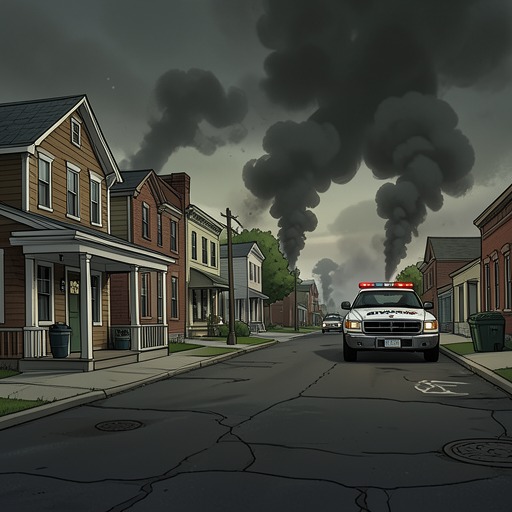
The CID arrives less than three minutes after Alan tells the officers to wait. Two cars arrive first, followed by Ray Van Allen in his Subaru; five minutes later, a State Police identification team arrives in a blue station wagon. The presence of the identification team makes the handoff visible: the State Police specialists begin the prolonged work of securing the scene, which continues until after dark.
Henry Payton, head of the Oxford Barracks, is in nominal charge of the case and of the CID personnel working on it. Alan considers Payton thorough and conscientious, and it is because Payton has been assigned that Alan feels safe stepping away briefly to call Polly Chalmers. Meanwhile, the teams document and handle evidence: the victims’ hands are placed in gallon-sized bags, Wilma’s missing shoe is treated in the same way, and the identification team takes close to three hundred photographs. The detailed procedure contrasts with the uncertain, exposed interval that preceded the specialists’ arrival.
Narrative Significance
The CID’s function is defined through a contrast between local familiarity and formal jurisdiction. Alan and his officers are present first and must contend with witnesses, onlookers, and the risk of disturbing evidence; the state unit arrives with the authority and personnel to conduct the murder investigation. The novel’s attention to the chain of evidence makes that boundary a source of tension rather than a mere administrative detail.
The unit also structures what Alan can do. He remains involved at the scene, but the assignment of Henry Payton and the CID allows him to step aside briefly, even while the investigation continues under state authority. In this way, the Criminal Investigation Department marks both the procedural limits on local policing and the organized forensic response that follows a violent crime in Castle Rock.